A free and open source editor for CSound
with Python and Lua support.

About

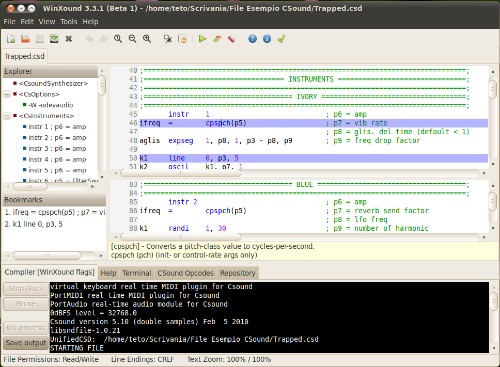
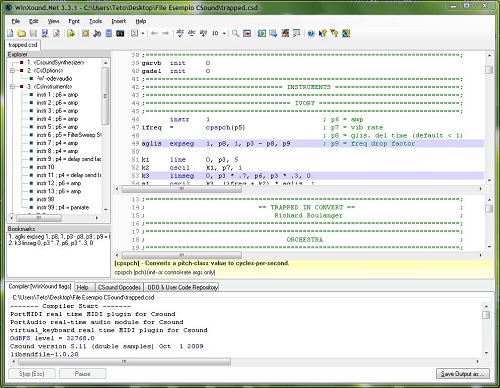
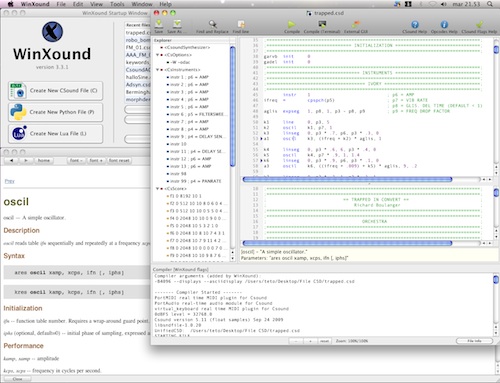
WinXound is a free and open source Front-End GUI Editor for CSound, CSoundAV, CSoundAC, with Python and Lua support, developed by Stefano Bonetti. It runs on Microsoft Windows, Apple OsX and Linux.


WinXound Features:
  • Edit CSound, Python and Lua files (csd, orc, sco, py, lua) with Syntax Highlight and Rectangular selection;
  • Run CSound, CSoundAV, CSoundAC, Python and Lua compilers;
  • Run external language tools (QuteCsound, Idle, or other GUI Editors);
  • CSound analysis user friendly GUI;
  • Integrated CSound manual help;
  • Possibilities to set personal colors for the syntax highlighter;
  • Convert orc/sco to csd or csd to orc/sco;
  • Split code into two view horizontally or vertically;
  • CSound csd explorer (File structure for Tags and Instruments);
  • CSound Opcodes autocompletion menu;
  • Line numbers;
  • Text-area rectangular selection;
  • Bookmarks;
...and much more ... (Download it!)

Omegagmgs2 Soundfont _hot_ -

Look for the latest version (typically v2.3 or higher).

Includes a wide array of percussion sets, including Roland GS and Yamaha XG variations.

With , it successfully captures the specific mapping differences between Yamaha XG and Roland GS percussion layouts, allowing complex drum rolls and sound effects (SFX) to render seamlessly out of the box. Sourcing the Sounds: A Blend of Silicon and Hardware

Download a virtual MIDI synthesizer like (by CoolSoft). omegagmgs2 soundfont

What started as a personal project in has become a two-decade-long mission. Rick has continuously refined and updated his creation, meticulously selecting, balancing, and mixing samples to create a cohesive and professional-sounding instrument bank. His goal was ambitious: to create a single SoundFont that could accurately play virtually any MIDI file, regardless of its format, without needing multiple different banks. The result, offered completely free of charge , is a testament to his dedication and a tremendous gift to the music community.

A (specifically in the .sf2 format) is a file containing recorded audio samples of real instruments mapped across a keyboard layout. When a computer reads a MIDI file, it triggers these samples to generate music.

This public link is valid for 7 days and shares a thread, including any personal information you added. This link or copies made by others cannot be deleted. If you share with third parties, their policies apply. Can’t copy the link right now. Try again later. Look for the latest version (typically v2

To appreciate the , you need to understand the frustration that birthed it. For decades, Windows users relied on the default Microsoft GS Wavetable Synth. That synth is actually a legally stripped-down version of Roland’s Sound Canvas (SC-55) from the early 1990s. While revolutionary then, by modern standards, it sounds aliased, muddy, and lifeless.

For composers working in modern Digital Audio Workstations (DAWs) like FL Studio, LMMS, or Reaper, OmegaGMGS2 functions as a lightweight, swiss-army-knife VST sound source. It allows you to rapidly sketch out arrangements using low CPU overhead before committing to heavy, multi-gigabyte contact libraries. 3. Digital Sheet Music Playback

The (specifically known as OmegaGMGS2.sf2) is one of the most celebrated, versatile, and enduring General MIDI (GM) soundfonts ever created for digital audio production and video game emulation. Originally developed by programmer and sound designer Kanji, this soundfont was engineered to breathe new life into standard MIDI files, balancing retro nostalgia with high-fidelity, realistic instrumentation. Sourcing the Sounds: A Blend of Silicon and

with a focus on balanced levels, avoiding the common issue of instruments sounding "mish-moshed" or imbalanced in a mix Compact Size

The default MIDI synthesizer in many operating systems is often basic, using low-quality, compressed samples that result in a flat and unrealistic sound. A custom SoundFont like OmegaGMGS2 replaces those lackluster samples with high-quality recordings, vastly improving the realism and overall musicality of any MIDI song.

Because a soundfont is just a raw data container of audio samples, it cannot be run as a standalone application. You need a MIDI synthesizer player or a Digital Audio Workstation (DAW) to host it.

It works excellently with software synthesizers like VirtualMIDISynth or TiMidity++ .

Whether you are a retro gamer looking to enhance the soundtracks of classic PC games like Doom and Duke Nukem 3D , or a music producer seeking a lightweight collection of diverse instruments, OmegaGMGS2 remains a gold standard in the MIDI community. What Makes OmegaGMGS2 Special?
DOWNLOADS

WINDOWS

WinXound 3.4.1 - Binary (29/03/2015 - 1021K)
WinXound 3.4.1 - Sources (29/03/2015 - 5463K)


OSX

WinXound 3.4.0 - Binary (03/11/2012 - 1598K)
WinXound 3.4.0 - Sources - Xcode 4.5.0 (03/11/2012 - 1927K)


LINUX

WinXound 3.4.0 - Binary 32 bit(23/07/2013 - 2613K)
WinXound 3.4.0 - Sources (23/07/2013 - 3121K)


NOTE

THE SOFTWARE IS PROVIDED "AS IS", WITHOUT WARRANTY OF ANY KIND, EXPRESS OR IMPLIED, INCLUDING BUT NOT LIMITED TO THE WARRANTIES OF MERCHANTABILITY, FITNESS FOR A PARTICULAR PURPOSE AND NONINFRINGEMENT. IN NO EVENT SHALL THE AUTHORS OR COPYRIGHT HOLDERS BE LIABLE FOR ANY CLAIM, DAMAGES OR OTHER LIABILITY, WHETHER IN AN ACTION OF CONTRACT, TORT OR OTHERWISE, ARISING FROM, OUT OF OR IN CONNECTION WITH THE SOFTWARE OR THE USE OR OTHER DEALINGS IN THE SOFTWARE.

Installation

Microsoft Windows
  • Download and install the latest version of CSound 5 (http://sourceforge.net/projects/csound);
  • Download the WinXound zipped file, decompress it where you want (see the note below), and double-click on "WinXound_Net" executable;
Note: WINXOUND FOLDER MUST BE LOCATED IN A PATH WHERE YOU HAVE FULL READ AND WRITE PERMISSION (for example in your User Personal folder).

Apple OsX
  • Download and install the latest version of CSound 5 (http://sourceforge.net/projects/csound);
  • Download the WinXound zipped file, decompress it and drag WinXound.app to your Applications folder (or where you want). Launch it from there.

Requirements
System requirements for Microsoft Windows:
- Supported versions: 7, 8, 8.1, 10 (32/64 bit versions);
- CSound: http://csound.com/download.html - (needed for CSound and LuaJit compilers);
- Not requested but suggested: CSoundAV by Gabriel Maldonado (http://www.csounds.com/maldonado/);
- Requested to work with Python: Python compiler (http://www.python.org/download/)

System requirements for Apple OsX:
- Supported versions: Osx 10.5 or major;
- CSound: http://csound.com/download.html - (needed for CSound compiler);

CONTACT

WinXound Developer


CSound Home Page

  https://csound.com/

CSound Download Page

  csound.com/download

INFO

Source Code

  • Windows: The source code is written in C# using Microsoft Visual Studio C# Express Edition 2008
  • OsX: The source code is written in Cocoa and Objective-C using XCode 3.2 version
  • Linux: The source code is written in C++ (Gtkmm) using Anjuta
  • For the OsX-Cocoa version of WinXound special thanks go to Giuseppe Silvi for the debugging help and other useful suggestions.
    The TextEditor is entirely based on the wonderful SCINTILLA text control by Neil Hodgson (http://www.scintilla.org).

Credits
Many thanks for suggestions and debugging help to Roberto Doati, Gabriel Maldonado, Mark Jamerson, Andreas Bergsland, Oeyvind Brandtsegg, Francesco Biasiol, Giorgio Klauer, Paolo Girol, Francesco Porta, Eric Dexter, Menno Knevel, Joseph Alford, Panos Katergiathis, James Mobberley, Fabio Macelloni, Giuseppe Silvi, Maurizio Goina, Andrés Cabrera, Peiman Khosravi, Rory Walsh, Luis Jure and Giovanni Doro.